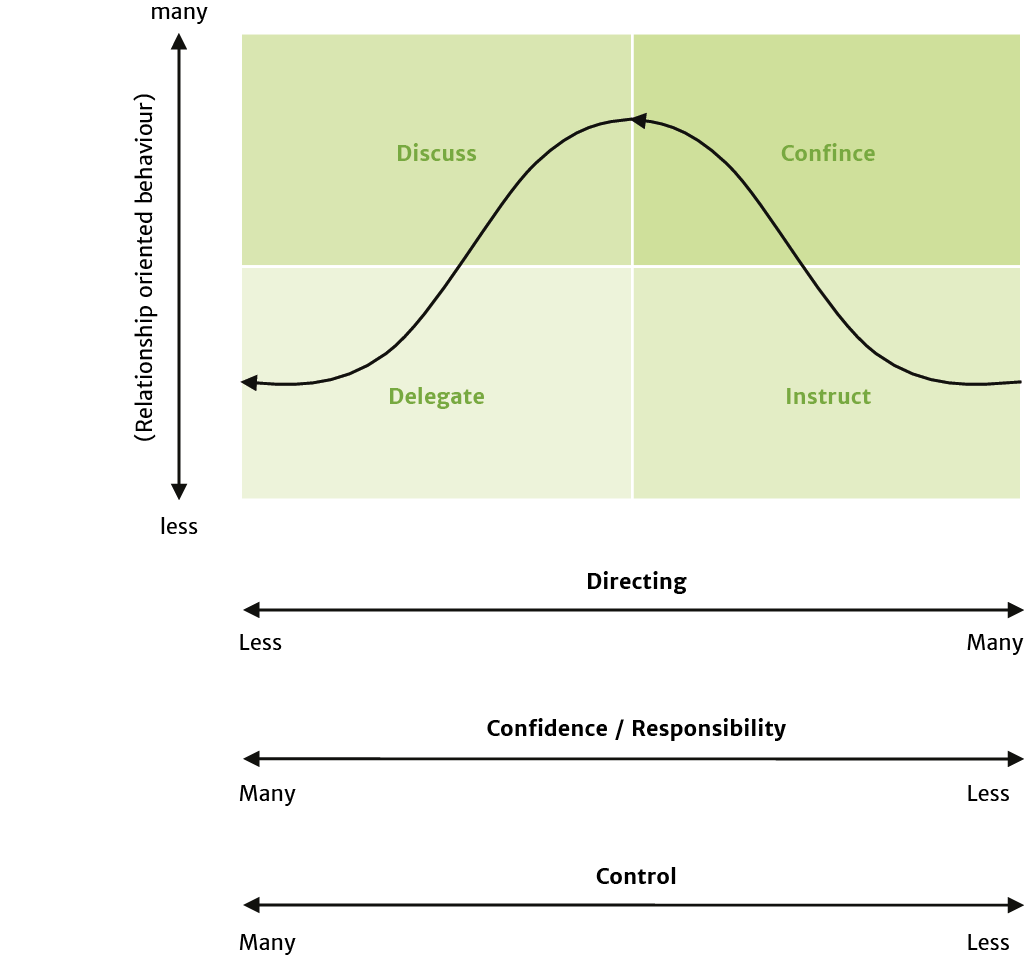
In one-to-one leadership relationships, the style is tuned per employee, per task. Two important dimensions are ‘motivation’ and ‘expertise’. In leadership relationships in relation to a group, the degree to which the working conditions (situations) appeal to the motivation and expertise of employees is decisive for the choice of leadership style.
Four leadership styles are recognised: Instructing, convincing, guiding and delegating. We deal with them briefly.
Instructing
Individual instruction is possible in cases where:
- the motivation is high;
- the expertise is low.
One is then open to receive the instruction. Be absolutely clear. Do not expect ‘you know that anyway’. Do not speak the language of the expert. Recognize the technical terms and explain them. At the end of the instruction ask if the person who received the instruction wants to repeat the assignment in his own words. These ‘own words’ are important because they allow you to test whether your instruction has been understood.
Collective can instruct you for example if:
- in (production) situations many planned and unforeseen events occur, which disrupt a normal course of events;
- there is a need for many clues;
- there are more emergencies which require immediate action.
Convincing
Convincing is a way of influencing. You make sure that the other person takes over something from you: an opinion, an idea, or a proposal. Convincing is a technique you can learn. But you can only be convincing if you are convinced of your message. The content and quality of your opinion and arguments are almost as important as the way you deliver it. Some people have it naturally: they have such an aura that others actually immediately accept from them what they say.
Individually you can guide in cases where:
- motivation is low;
- expertise is low.
And collectively you choose to convince, for example if:
- in the situation the mutual interaction must be intensive to achieve results;
- in the situation the employees are strongly dependent on each other to work effectively (teamwork);
- there are issues where more than one effective solution is possible and consultation increases the quality of the solutions.
Discussing
Individual consultation is done in cases where:
- the motivation is mediocre;
- the expertise is mediocre.
And collective for example if:
- the situation of the employees requires creativity and technical skills;
- the situation requires a high degree of involvement of the employees;
- the employees themselves can choose which method, means and approach they want to use.
Discussing may approach the principles of coaching the most. Stimulating, sometimes just pretending. Attentioning in time, without saying ‘yes’. But above all, let the coachee himself get to work. Give feedback. Continue what is going well; identify points for improvement; first give the coachees the opportunity to do it themselves.
Delegating
Delegating is clearly transferring tasks and own decision-making powers to the right employees and supervising their implementation. This also means: always making agreements about feedback. ‘Keep me informed by telephone once a week’, or in extreme cases ‘As long as I don’t hear from you, I assume things are going well’. But then you really have to be sure of your business.
Therefore you can delegate individually in cases where:
- the motivation is high;
- the expertise is high.
And collective for example if:
- the tasks are to be carried out well and the employees themselves can assess their own effectiveness;
- the work itself is motivating and attractive to employees;
- work and working methods are carried out according to established principles.